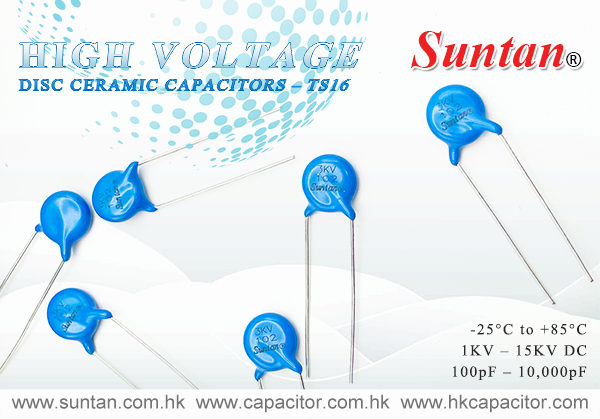
SUNTAN HIGH VOLTAGE DISC CERAMIC CAPACITORS – TS16
May 23, 2023 Views
Comments 0
Suntan Technology Company Limited
----All Kinds of Capacitors
This week, we would like to introduce HIGH VOLTAGE DISC CERAMIC CAPACITORS – TS16, with below features:
Use for coupling, and by-pass circuit there are a stable and high reliability products.
Operating Condition Range: -25°C to +85°C
Rated Working Voltage: 1KV – 15KV DC
Capacitance Range: 100pF – 10,000pF
Test Voltage: UR≤500V, U=2.5UR;UR>500V≤6KV, U=1.5UR+500V
UR>6KV≤15KV, U=1.5UR
Insulation Resistance: YL/SL/NPO:≥10GΩ
Y5R/Y5P/Y5U/Y5V/Y5T: CR≤25nF,≥4000MΩ, CR>25nF,Rj.CR≥100s
Welcome to contact us to know more about our parts.
More..Ceramic Capacitor