...SUNTAN TECHNOLOGY COMPANY LIMITED · CIRCUIT PROTECTION SPECIALIST
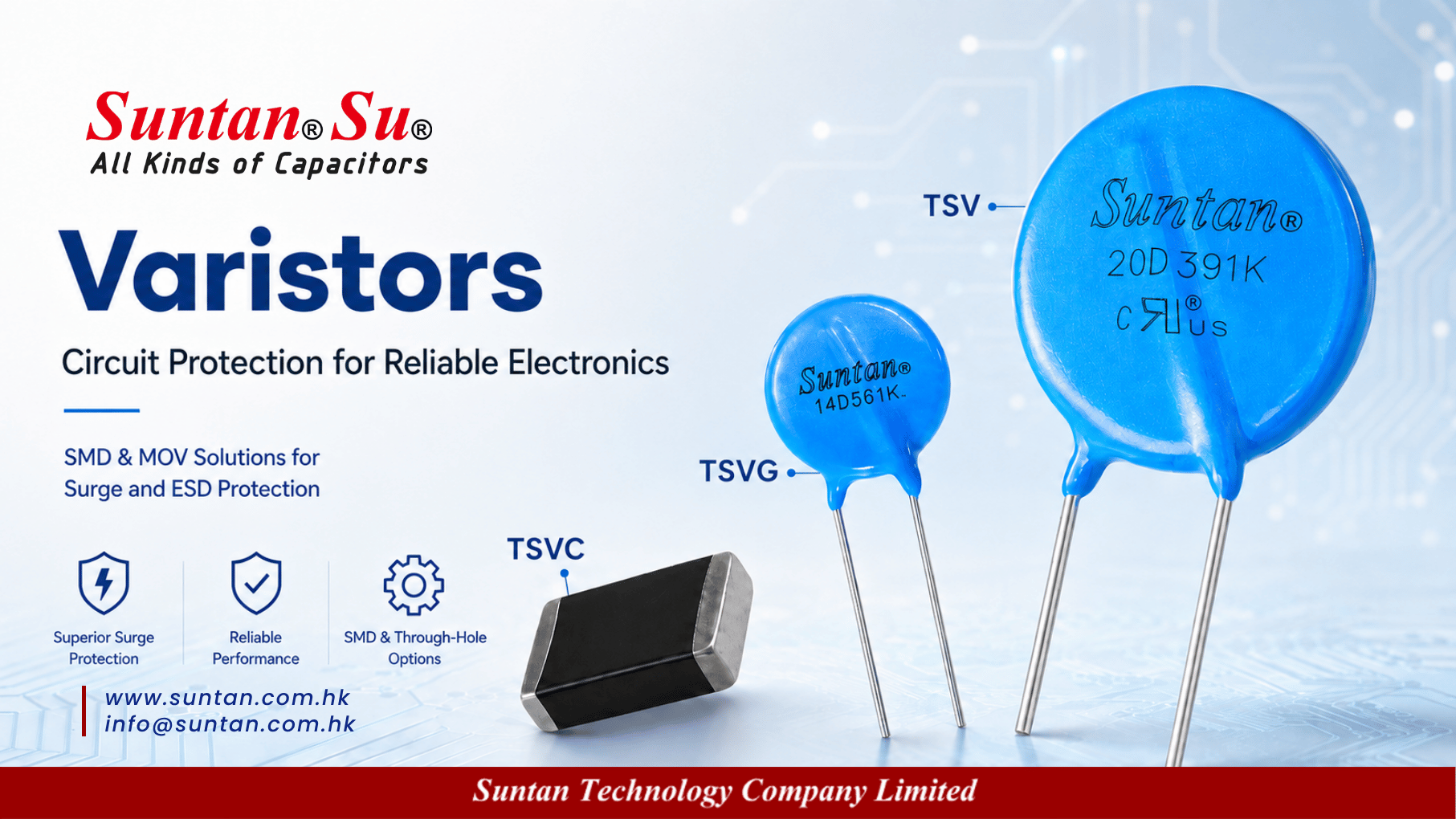
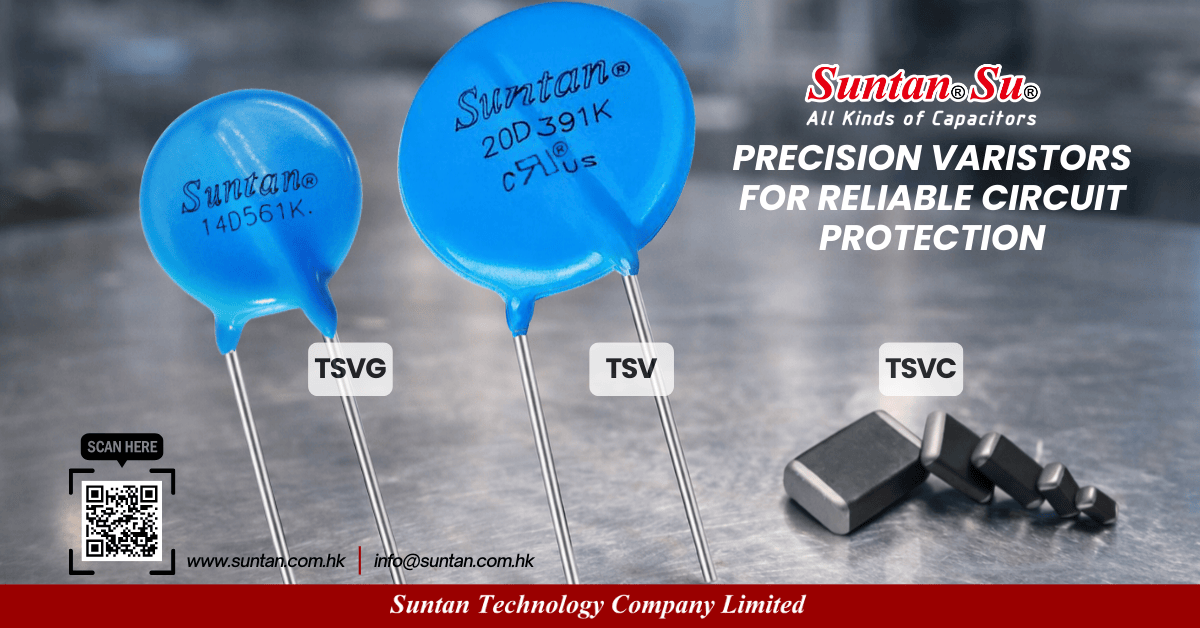
Figure 1: Comprehensive Suntan® varistor lineup spanning standard TSV MOVs, high-temperature TSVG, and surface-mount TSVC chip varistors.
Varistor Selection for Emerging Power Electronics: Safeguarding AI Data Centers, EV Charging, ESS, and Robotics
The accelerating transformation across high-power computational facilities, electric mobility, renewable storage, and industrial automation has introduced unprecedented voltage transient challenges. In architectures such as high-density AI data center power distribution units (PDUs), commercial EV DC fast chargers, photovoltaic energy storage systems (ESS), and collaborative robotics, circuits face severe lightning surges, continuous switching transients, and inductive kickbacks.
Suntan Technology Company Limited® provides a versatile circuit protection portfolio engineered to mitigate these risks. By combining standard zinc oxide metal oxide varistors (TSV Series), upgraded high-temperature and high-surge varistors (TSVG Series), and sub-nanosecond response multilayer chip varistors (TSVC Series), Suntan delivers scalable overvoltage and electrostatic discharge (ESD) suppression tailored to modern electronic designs.
Overvoltage Protection in Growing Power Electronics Sectors
Hardware engineers and sourcing teams face strict safety standards (UL 1449, VDE, IEC 61000-4-5) across critical growth markets:
AI Data Center & Server Power Shelves: Fast-switching multi-phase VRMs and 48V bus architectures demand high-energy MOVs on the AC primary side to prevent downtime from utility grid transients, paired with low-capacitance SMD varistors on high-speed telemetry lines.
EV Fast Charging Infrastructure: Outdoor charging piles operate under harsh environmental conditions with exposure to lightning-induced surges and high-current relay transients during vehicle connection.
Solar Inverters & ESS: Rapid DC-to-AC conversion and battery rack switching produce continuous inductive back-EMF, requiring varistors with robust thermal endurance to prevent catastrophic thermal runaway.
Robotics & Motion Control: Servo drive electronics and motor braking circuits require compact, vibration-resistant transient suppression at power terminals and fieldbus communication nodes.
Suntan® Varistor Series Comparison & Technical Matrix
The table below compares key electrical parameters and design contexts across Suntan's primary varistor platforms:
The physical disc diameter of an MOV directly governs its peak pulse current capability (8/20 μs waveform) and total energy absorption (measured in Joules for a 2ms pulse). Selecting the correct size ensures reliable protection while optimizing PCB footprint:
Disc Diameter
Peak Surge Current (8/20 μs, 1 Time)
Typical Energy Absorption (2ms)
Recommended Application Context
7D (7mm)
1,200A – 1,750A
Approx. 9J – 30J
Compact auxiliary power supplies, LED drivers, smart meters, IoT devices
10D (10mm)
2,500A – 3,500A
Approx. 25J – 70J
Standard desktop power adapters, white goods, residential appliances
14D (14mm)
4,500A – 6,000A
Approx. 50J – 150J
Industrial SMPS, telecom rectifiers, solar microinverters (e.g., 14D471K)
20D (20mm)
6,500A – 10,000A
Approx. 130J – 360J
Heavy industrial motor drives, EV charging stations, building service panels (e.g., 20D391K)
People Also Ask — Varistor Selection & Engineering FAQ
What size MOV should I use?
MOV disc diameter (7D, 10D, 14D, 20D) governs peak surge current handling (8/20 μs) and energy absorption (Joules). For compact adapters and small auxiliary circuits, 7D or 10D is standard. For industrial power equipment, outdoor EV chargers, and AI server power shelves, 14D and 20D models are strongly recommended to withstand severe transient spikes without degradation.
Follow a three-step selection procedure: 1) Identify the continuous operating voltage (VRMS for AC or VDC for DC) and add a 15% to 25% safety headroom to prevent premature conduction during normal line fluctuations; 2) Choose a nominal Varistor Voltage (V1mA) matching that threshold; 3) Verify that the maximum Clamping Voltage (VC) at expected peak surge currents remains below the maximum breakdown rating of downstream components.
Is a bigger MOV always better?
A larger MOV disc (e.g., 20D vs. 10D) provides higher surge current capacity, lower thermal stress, and longer operating life under repetitive surge conditions. However, trade-offs include higher cost, larger PCB footprint, greater height, and increased parasitic capacitance. Hardware designers must balance required surge robustness against physical layout constraints.
What is the difference between an MOV and an SMD varistor?
Radial leaded disc MOVs (Suntan TSV and TSVG) are designed primarily for primary AC and DC power lines to absorb high-energy, high-current surges (in the kilo-ampere range). In contrast, SMD multilayer chip varistors (Suntan TSVC) protect low-voltage secondary circuits and high-speed data interfaces (USB, Ethernet, CAN) against fast-rising electrostatic discharge (ESD) and low-energy transients with sub-nanosecond response times.
For standard 230V AC utility grids, voltage fluctuations can reach 265V AC or higher. Therefore, the varistor's continuous maximum AC voltage (VRMS) must be at least 275V to 300V. Common industry choices include nominal 430V or 470V varistor voltage models (such as 14D431K or 14D471K), depending on localized surge test specifications.
What does 14D471K mean?
This standard part number code designates: • 14D: 14mm disc diameter body size; • 471: Nominal varistor voltage of 47 × 101 = 470V (measured at 1mA DC); • K: Voltage tolerance of ±10%.
What does 20D391K mean?
This part number designates a heavy-duty surge varistor: • 20D: 20mm disc diameter capable of handling up to 6,500A peak surge current; • 391: Nominal varistor voltage of 39 × 101 = 390V at 1mA; • K: Tolerance of ±10%. Frequently selected for 220V/240V AC power systems requiring a tight clamping threshold.
How much surge current can an MOV handle?
Surge handling is evaluated using standard 8/20 μs current pulses. Standard 7D discs manage up to 1,200A; 10D discs handle 2,500A; 14D discs handle 4,500A; and 20D discs handle 6,500A or higher. Upgraded TSVG high-surge series provide enhanced pulse endurance and elevated thermal endurance up to +105°C.
Can varistors protect against ESD?
Yes, but selection of the correct construction is critical. While radial MOVs are too slow and excessively capacitive for high-speed data lines, Suntan TSVC Multilayer Chip Varistors are specifically engineered for IEC 61000-4-2 ESD protection, featuring sub-nanosecond response times (<0.5ns) and low parasitic capacitance.
What capacitance should ESD protection have for USB interfaces?
For high-speed communication interfaces like USB 2.0, excessive parasitic capacitance causes severe signal degradation and eye-diagram distortion. According to the Suntan TSVC engineering datasheet, varistor capacitance should be selected below 4pF (with ultra-low capacitance options <1pF recommended for ultra-high-speed differential pairs).
A varistor must be positioned as close as possible to the power input connector or entry port, directly downstream of the primary fuse or thermal cutoff. PCB traces connecting to the varistor must be short and wide to minimize parasitic trace inductance, ensuring transient spikes are clamped before propagating into sensitive circuits.
How do I know when an MOV needs replacement?
MOVs experience gradual degradation after absorbing repetitive transient energy pulses. Symptoms of aging include increased leakage current, decreased nominal breakdown voltage (V1mA), and elevated steady-state operating temperature. In severe overstress conditions, visible discoloration or body cracking occurs. Incorporating a series thermal disconnect (TMOV configuration) helps prevent catastrophic short-circuit failures at end of life.
Suntan® supports emerging power electronics, AI server power shelves, EV charging networks, and industrial robotics with certified circuit protection components. For engineering cross-referencing or custom sample kits, please contact our support team.
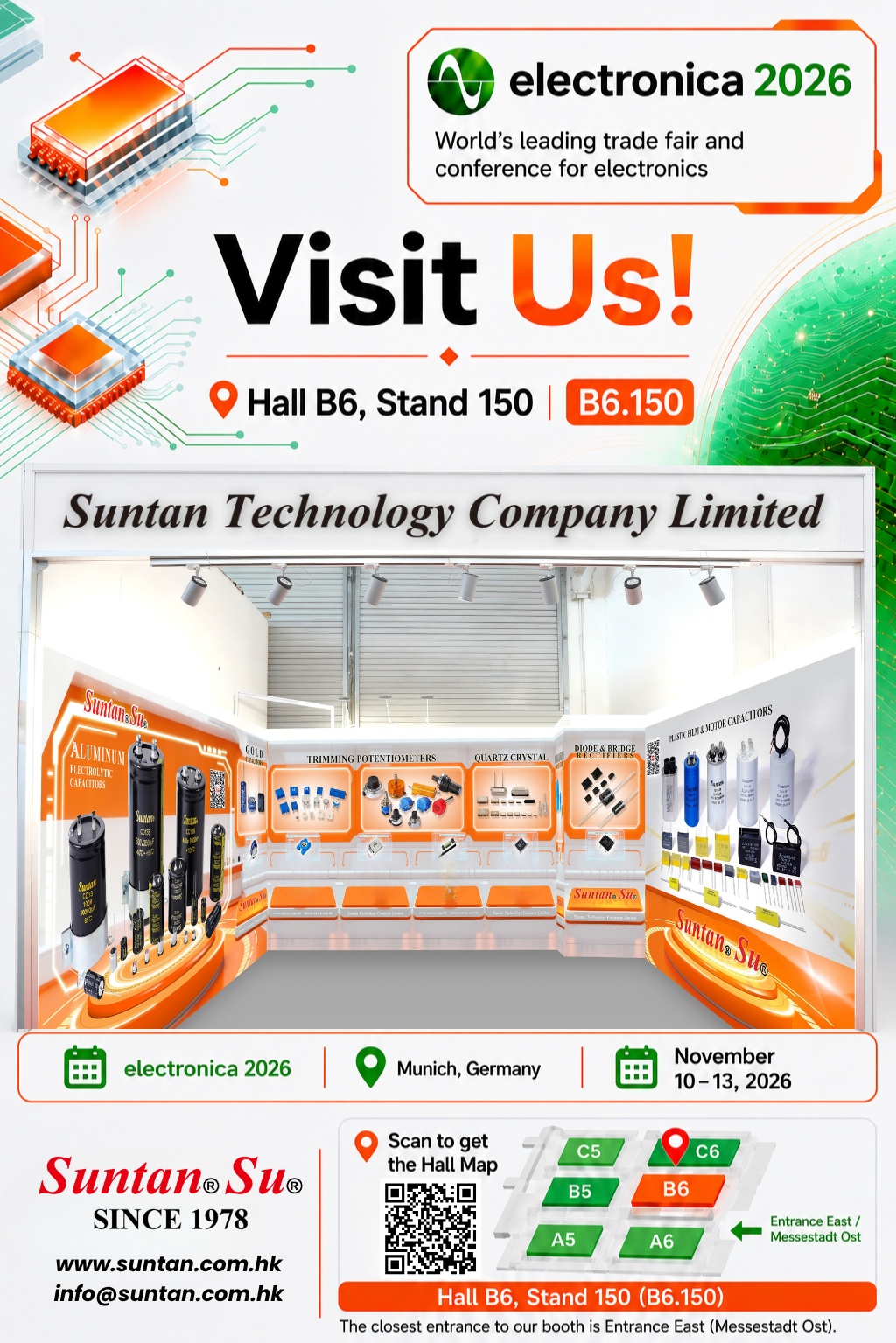
Q1: Where is Suntan located at electronica 2026, and what are the exhibition dates?
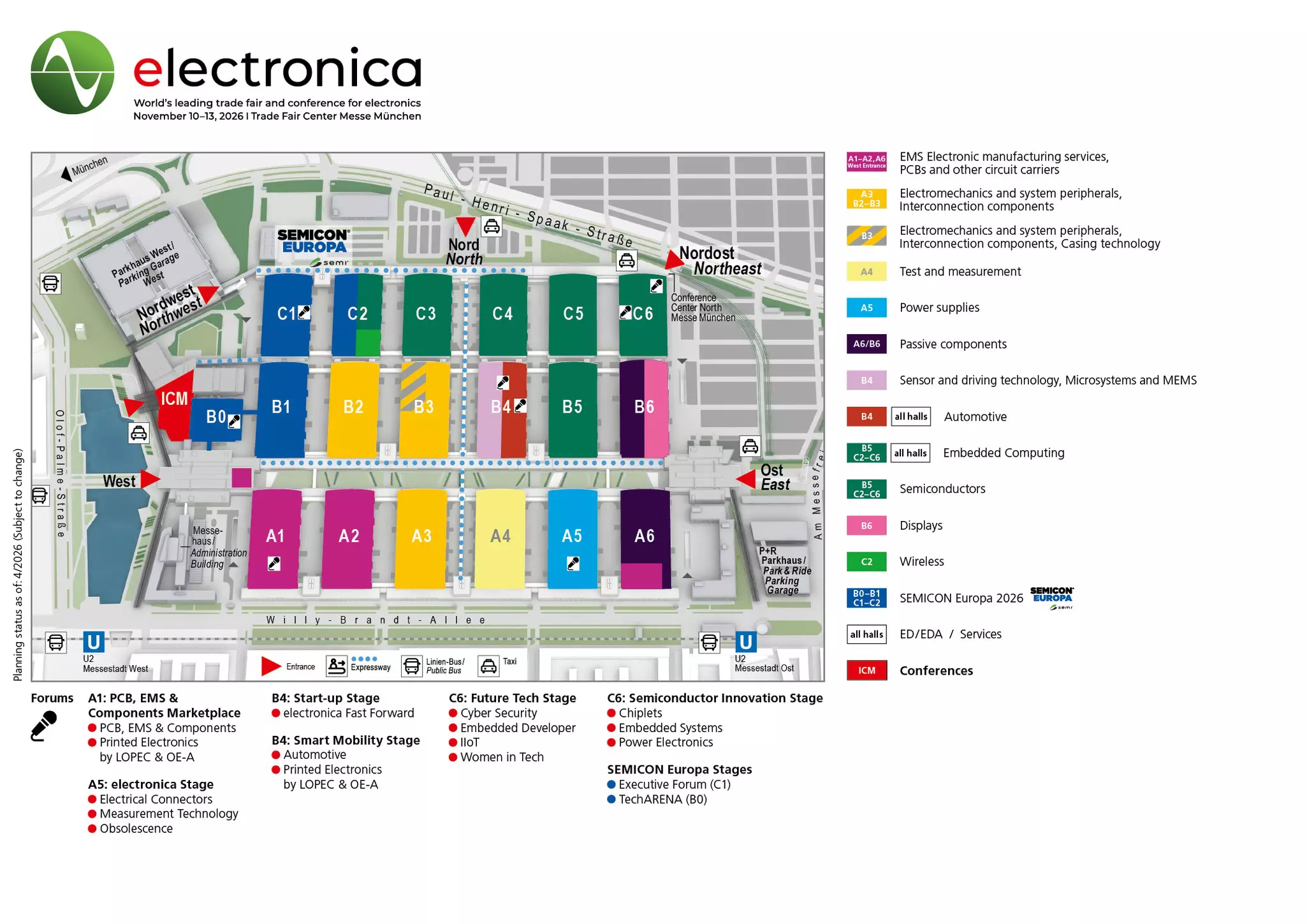
A:electronica 2026 takes place from November 10 to 13, 2026, at the Trade Fair Center Messe München, Germany. You can visit Suntan Technology Company Limited at Hall B6, Stand 150.
Q2: What interactive activities and giveaways can visitors expect at Suntan’s booth?
A: Visitors who exchange business cards with our team can join the "Su Timer Challenge" to win exclusive souvenirs (Foldable Eco Bags, Luggage Covers, Magnifiers, Embroidered Pouches, or Magic Cubes). Guests can also collect complimentary copies of our newly released 2026 Product Selection Guide and inspect physical component samples live on-site.
Q3: How do I schedule a business meeting or technical consultation with Suntan during the show?
A: To secure a dedicated one-on-one meeting with our engineering specialists or management team, please contact your dedicated Suntan sales representative directly in advance. You can also reach out through our official Contact Us page. Scheduling your visit ahead of time allows us to prepare targeted product samples, cross-reference matrices, and project solutions tailored specifically to your needs.
As the world's leading and most authoritative trade fair for electronic components, systems, and applications, electronica 2026 will be held from November 10 to 13, 2026, at Messe München, Germany. Continuing our long-standing dedication to the global electronics industry (view our Exhibition History), Suntan Technology Company Limited is excited to welcome industry partners and clients in Munich once again.
(Hall Map attached below)
Figure : electronica 2026 Hall Map at Trade Fair Center Messe München
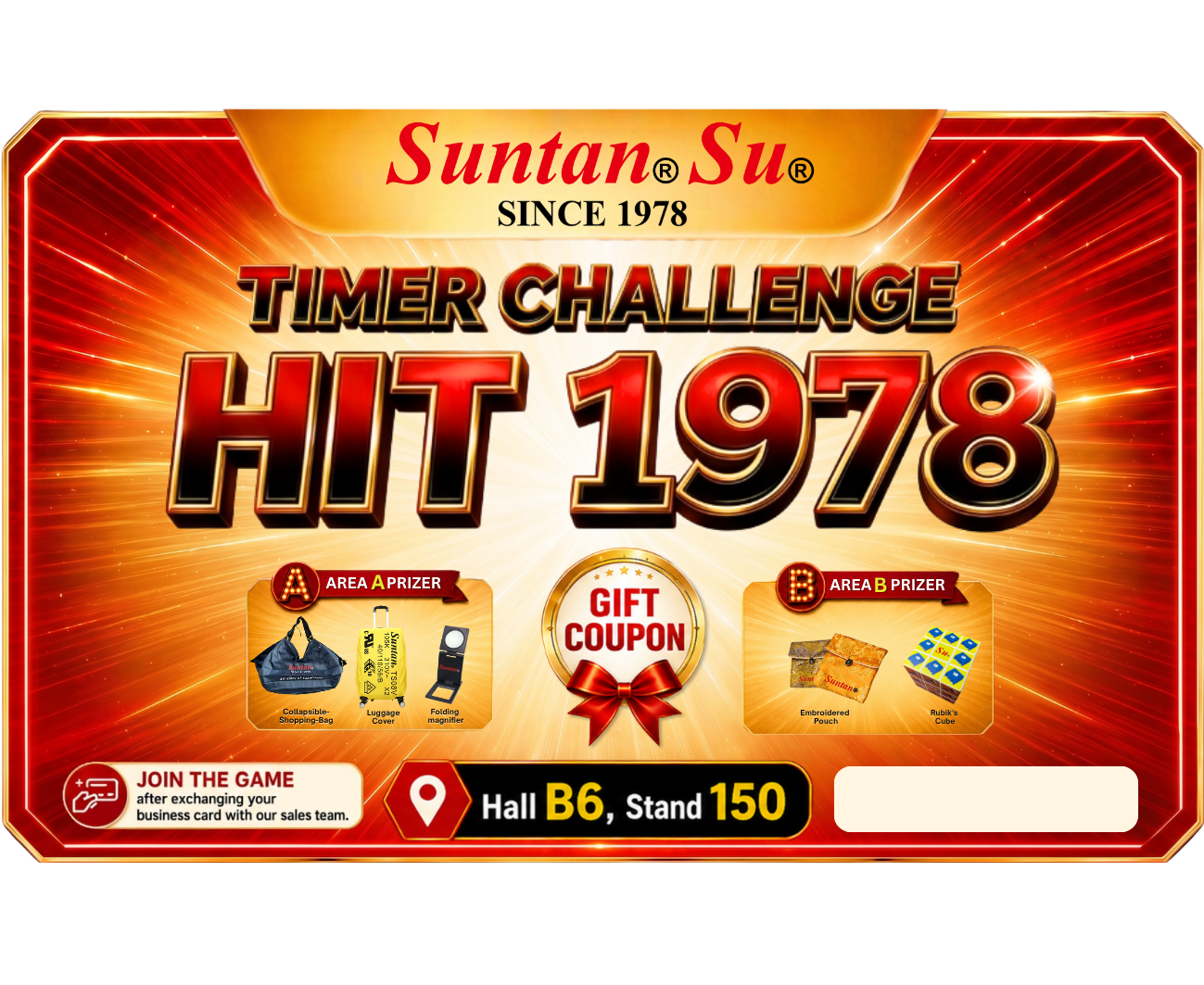
Join our exclusive booth event—the "Su Timer Challenge"—commemorating Suntan's founding year, 1978! Simply consult with our sales team and exchange business cards to receive an official challenge ticket. Test your precision on our digital timer:
★ GRAND PRIZEExact 19.78s:Win 2 Gifts (1 from Zone A + 1 from Zone B)
ZONE A PRIZEUnder 19.78s:Choose 1 from Foldable Eco Bag, Luggage Cover, or Magnifier
ZONE B PRIZEOver 19.78s:Choose 1 from Embroidered Pouch or Magic Cube
Visit Hall B6, Stand 150, connect with our component specialists, and take home exclusive Suntan souvenirs!
Precision Timer Challenge Device
Challenge Voucher Card
Pick Up the 2026 Product Guide & Inspect Live Samples
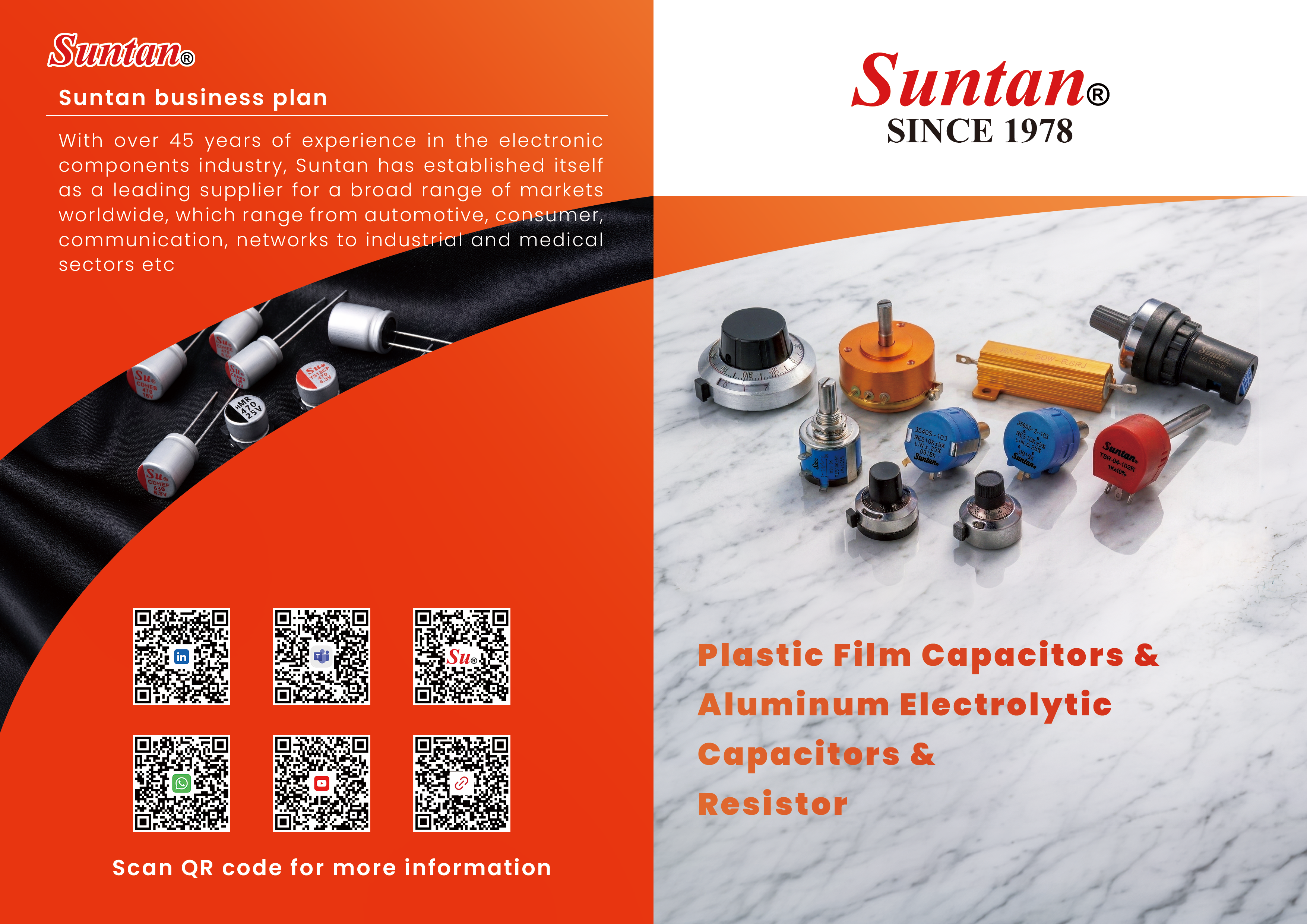
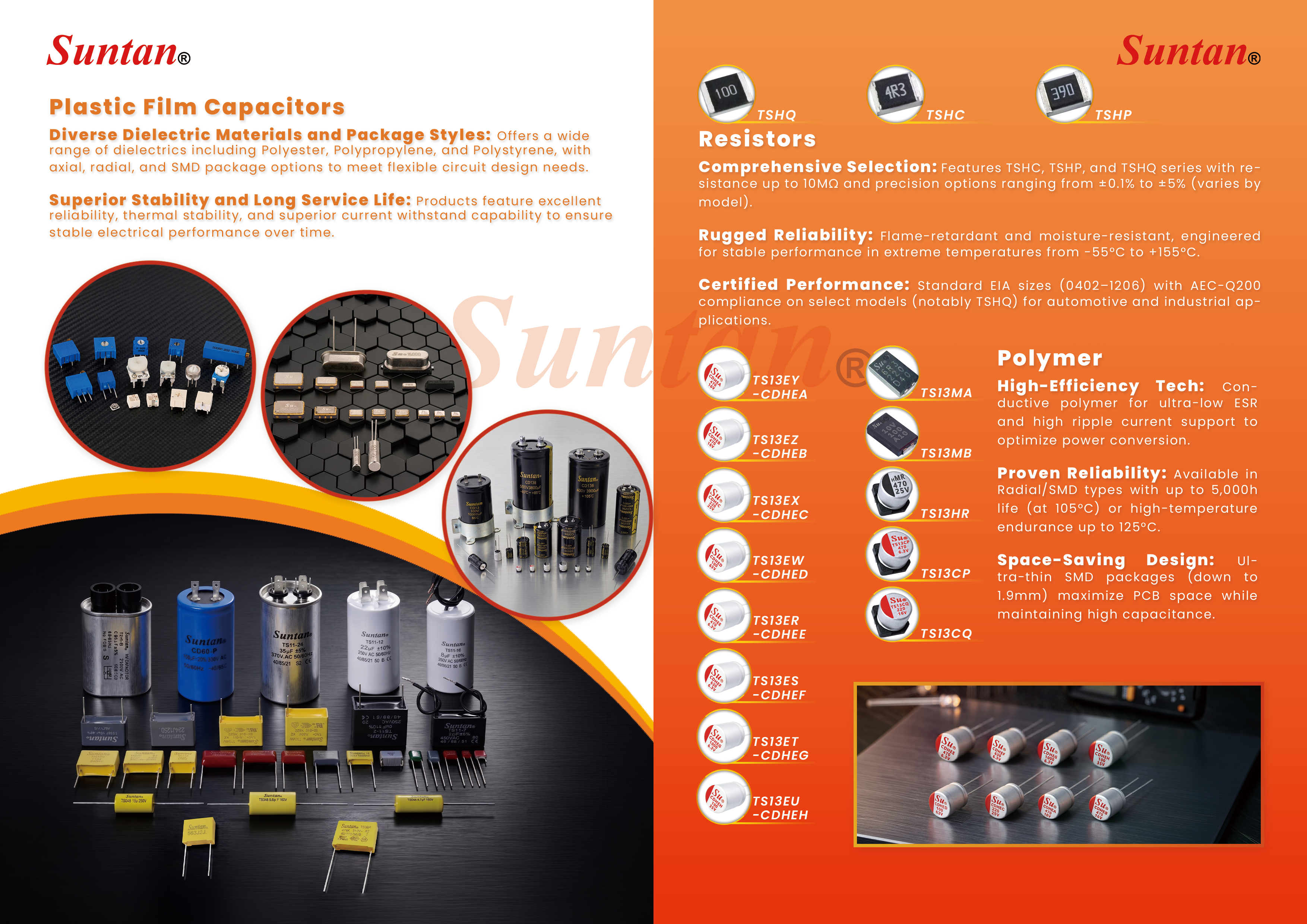
Visit Hall B6, Stand 150 to pick up the newly released Suntan 2026 Product Guide, featuring our three core product lines: Capacitors (Film, Aluminum Electrolytic, Ceramic & Super Capacitors), Trimming Potentiometers, and Bridge Rectifiers & Rectifier Diodes. Engineers and sourcing specialists are warmly invited to inspect live samples and discuss design requirements directly with our team.
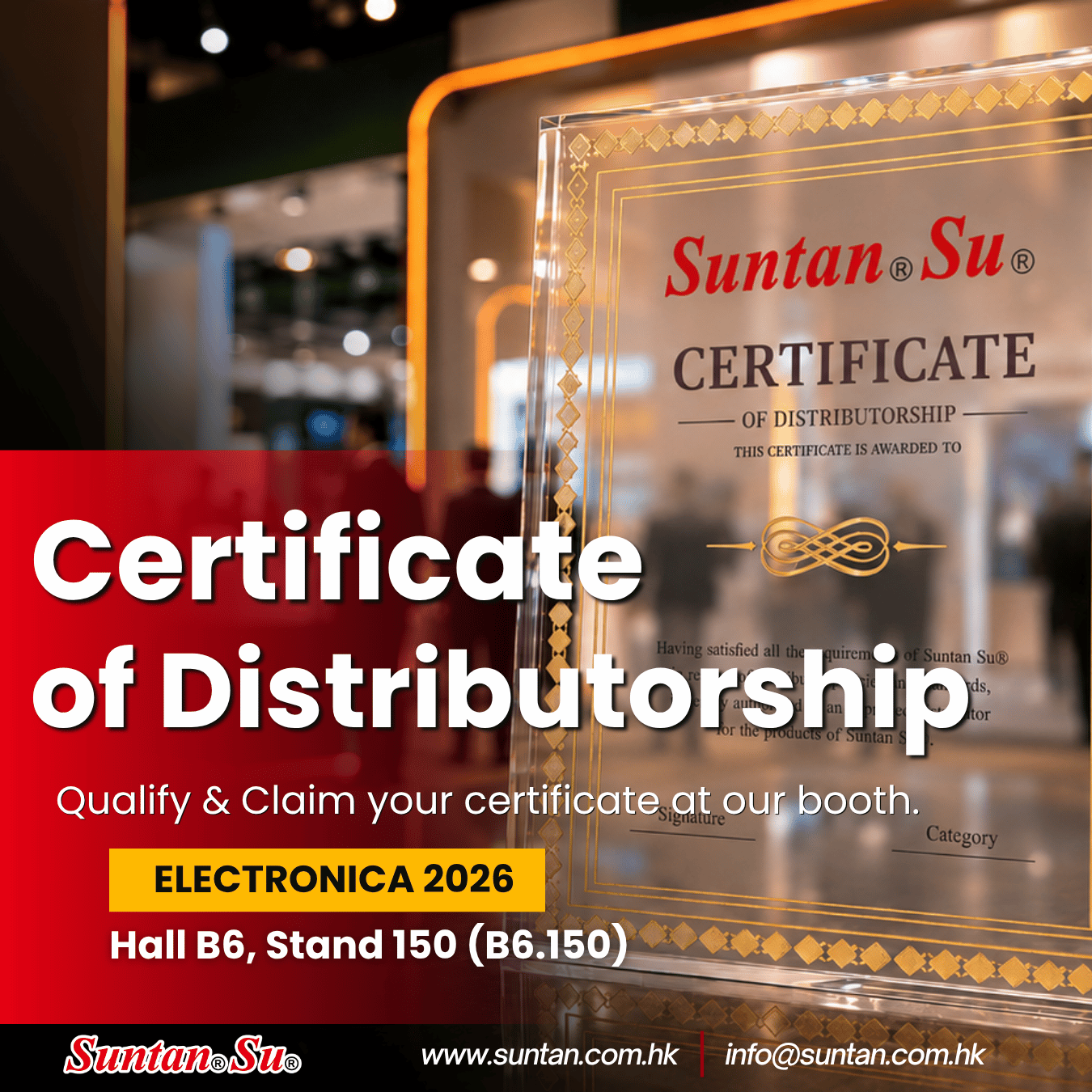
Exclusive for Distributors: Reserve & Collect Your Physical Certificate at electronica 2026
Suntan is currently running a special event across our social channels on LinkedIn and Facebook for our valued distributor partners. Simply follow or like our event post and contact your dedicated Suntan sales representative in advance to schedule an on-site appointment and collect your official, physical Authorized Distributor Certificate at Hall B6, Stand 150.
Official Suntan Authorized Distributor Certificate
Meet Suntan at electronica 2026 & Get in Touch
We warmly invite all engineers, procurement professionals, and industry partners to visit Suntan Technology Company Limited at Hall B6, Stand 150 during electronica 2026. Explore our comprehensive component lineups, participate in our booth challenges, and collect your printed catalogs and distributor certificates.
For technical inquiries, sample requests, or to schedule a dedicated on-site meeting with our team in advance, please feel free to contact us. We look forward to meeting you in Munich — for any questions before or during the show, or to arrange your appointment time, please don't hesitate to reach out to your dedicated Suntan sales representative.
SUNTAN TECHNOLOGY COMPANY LIMITED · BRIDGE RECTIFIERS SPECIALIST
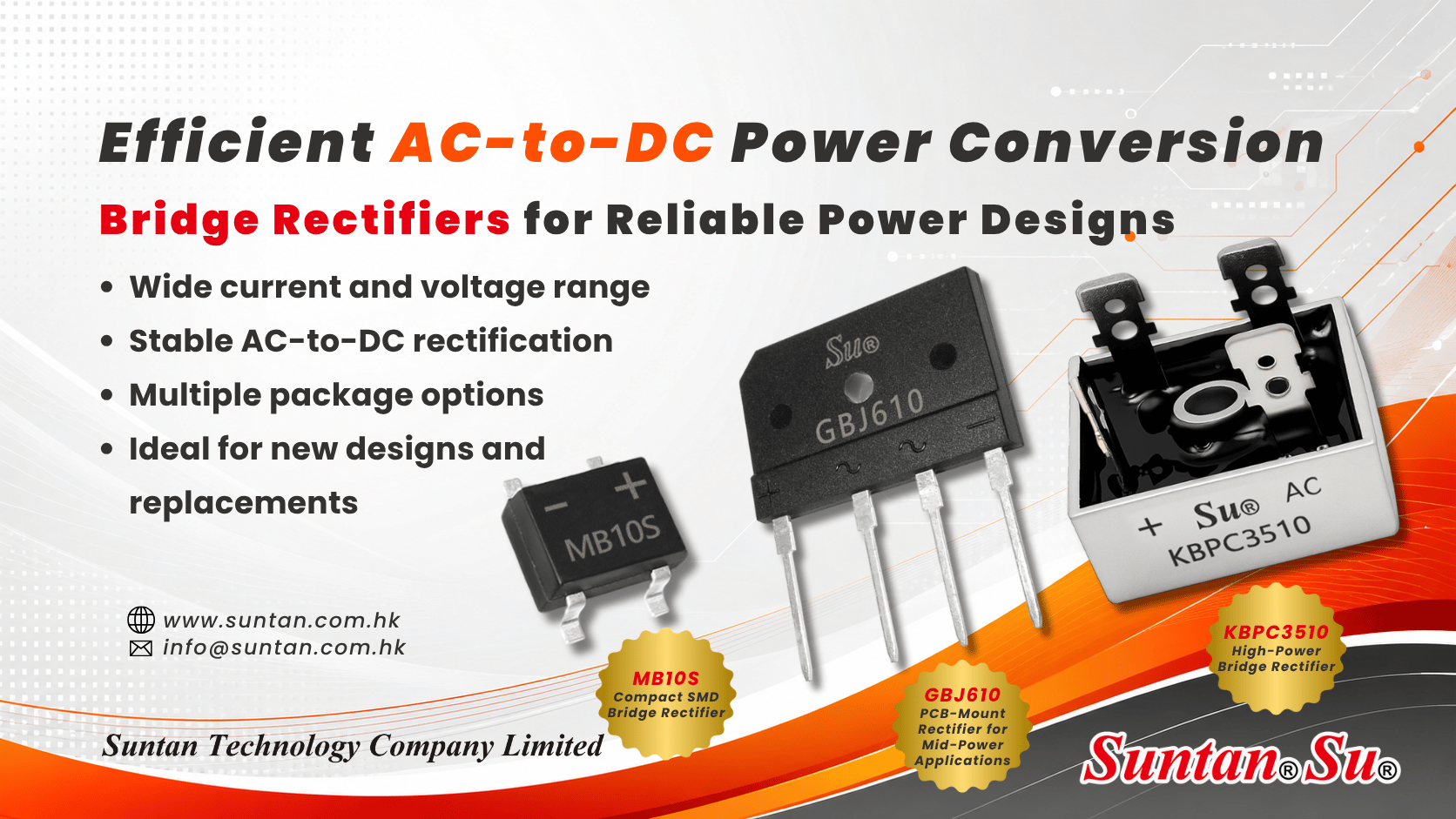
Figure 1: Comprehensive Suntan® bridge rectifier lineup spanning from low-profile 0.8A SMD MB10S to heavy-duty 35A industrial rectifiers.
From 0.8A to 35A: Choosing the Right Bridge Rectifier for Your Power Design
In modern AC-to-DC power conversion architectures, selecting the optimal full-wave bridge rectifier is a fundamental engineering requirement. Whether designing low-power SMT consumer chargers, medium-power industrial PCB control boards, or heavy-duty power inverters, power electronics engineers must evaluate key parameters including average forward current (IF(AV)), maximum peak reverse voltage (VRRM), peak forward surge current (IFSM), and thermal dissipation efficiency.
Suntan Technology Company Limited® offers an extensive portfolio of silicon bridge rectifiers engineered for high reliability, low forward voltage drop, and high surge capability. From space-saving 0.8A SMD packages like the MB10S to 6A PCB-mounted models like the GBJ610, up to heavy-duty 35A industrial chassis rectifiers such as the KBPC3510 and S35VB005–S35VB100 series, Suntan provides scalable power rectification options across global commercial and industrial applications.
Why Current Rating, Reverse Voltage, and Package Selection Matter
Selecting an under-specified bridge rectifier can lead to thermal runaway, excessive forward voltage dissipation, or destruction from line transients and initial bulk capacitor inrush currents. To ensure long-term field reliability, hardware designers must balance electrical margins with mechanical constraints:
Average Rectified Forward Current (IF(AV)): The maximum continuous DC current the rectifier can safely pass without exceeding its junction temperature limits. Applying a 30% to 50% safety de-rating margin above maximum continuous circuit load is highly recommended.
Peak Reverse Voltage (VRRM): The maximum repetitive voltage the diode junction can block in reverse bias. For 110V/220V AC utility line inputs, selecting a 1000V VRRM rating (e.g., MB10S, GBJ610, KBPC3510) guards against power grid voltage spikes and inductive switching surges.
Thermal Management & Casing: Low-current SMD rectifiers dissipate heat through PCB copper traces. Mid-to-high current rectifiers (6A to 35A) feature single-in-line or square metal/ceramic housings designed for external aluminum heatsinks to handle heavy power losses.
Technical Parameters and Bridge Rectifier Series Comparison
The table below summarizes key technical parameters for primary Suntan® bridge rectifier series across current ratings, package styles, and target applications:
Bridge Rectifier Series
Current / Voltage Rating
Package & Mounting Type
Primary Application Focus
Datasheet Reference
MB10S
0.8A / 1A | 1000V VRRM
MBS Miniature Surface Mount (SMD / SMT)
Compact PCB power supplies, smart meters, LED drivers, consumer adapters.
How do I determine the required bridge rectifier current rating?
Calculate the maximum continuous DC output load current (IDC) of your circuit and apply a safety de-rating factor of 30% to 50% (or higher for inductive motor loads). This overhead accommodates elevated ambient operating temperatures and prevents device thermal runaway.
What is the difference between SMD and through-hole bridge rectifiers?
SMD bridge rectifiers (such as the MB10S) are optimized for automated high-speed SMT assembly in compact, low-power designs. Through-hole models (such as the GBJ610) feature leads passing through PCB holes, providing stronger mechanical anchoring and better thermal dissipation for medium-to-high power converters.
How much reverse voltage (VRRM) headroom is needed for AC line inputs?
Select a peak reverse voltage rating at least 1.5× to 2× higher than the peak AC input voltage (VAC_peak = VRMS × 1.414). For standard 220V/240V AC line applications, choosing a 1000V rated model (such as MB10S, GBJ610, or KBPC3510) provides ample protection against line transients.
Can a higher-current bridge rectifier replace a lower-current model?
Yes. Electrically, a higher-current bridge rectifier (e.g., replacing a 6A model with a 35A series) can safely substitute for a lower-current device. However, engineers must verify physical pin pitch, lead dimensions, terminal type, and heatsink clearance on the PCB or chassis.
What is the difference between KBPC3510 and S35VB100 rectifiers?
Both KBPC3510 and S35VB100 deliver 35A 1000V AC-to-DC rectification. The key distinctions involve housing dimensions, internal construction layout, mounting hole isolation, and terminal configurations (such as faston tab terminals vs wire pin leads) for specific chassis installations.
What does surge current (IFSM) mean in a bridge rectifier datasheet?
Surge current (IFSM) represents the maximum non-repetitive peak forward surge current the rectifier diode junctions can withstand for a single half-sine wave pulse (typically 8.3ms at 60Hz). A robust IFSM rating is essential to handle bulk filter capacitor charging inrush current upon power turn-on.
Does a 35A bridge rectifier require an external heatsink?
Yes. When operating at high continuous currents, internal diode forward voltage drop causes significant power loss (P = VF × Iload). Heavy-duty 35A rectifiers like KBPC3510 and S35VB require an adequately sized aluminum heatsink with thermal compound to maintain safe junction temperatures.
Which bridge rectifier is best for miniature SMT power supplies?
The MB10S miniature SMD bridge rectifier is an ideal choice for compact PCB power converters due to its low-profile MBS package, automated SMT compatibility, high reliability, and standard 1000V peak reverse voltage capability.
Is GBJ610 suitable for high-density PCB power converters?
Yes. The GBJ610 features a slim single-in-line (SIP) footprint that minimizes PCB surface area usage while allowing easy mounting of a vertical metal heatsink for up to 6A continuous output current.
How should buyers prepare a bridge rectifier RFQ for volume procurement?
Sourcing teams should specify required average forward current (IF), maximum peak reverse voltage (VRRM), package style (SMD, GBJ, or KBPC), expected order volume, and application target when submitting a Request for Quotation (RFQ) to Suntan.
Suntan® supports industrial power supplies, motor control units, and commercial electronics with reliable bridge rectifier solutions. For volume pricing and technical sample evaluation, please contact our support team.
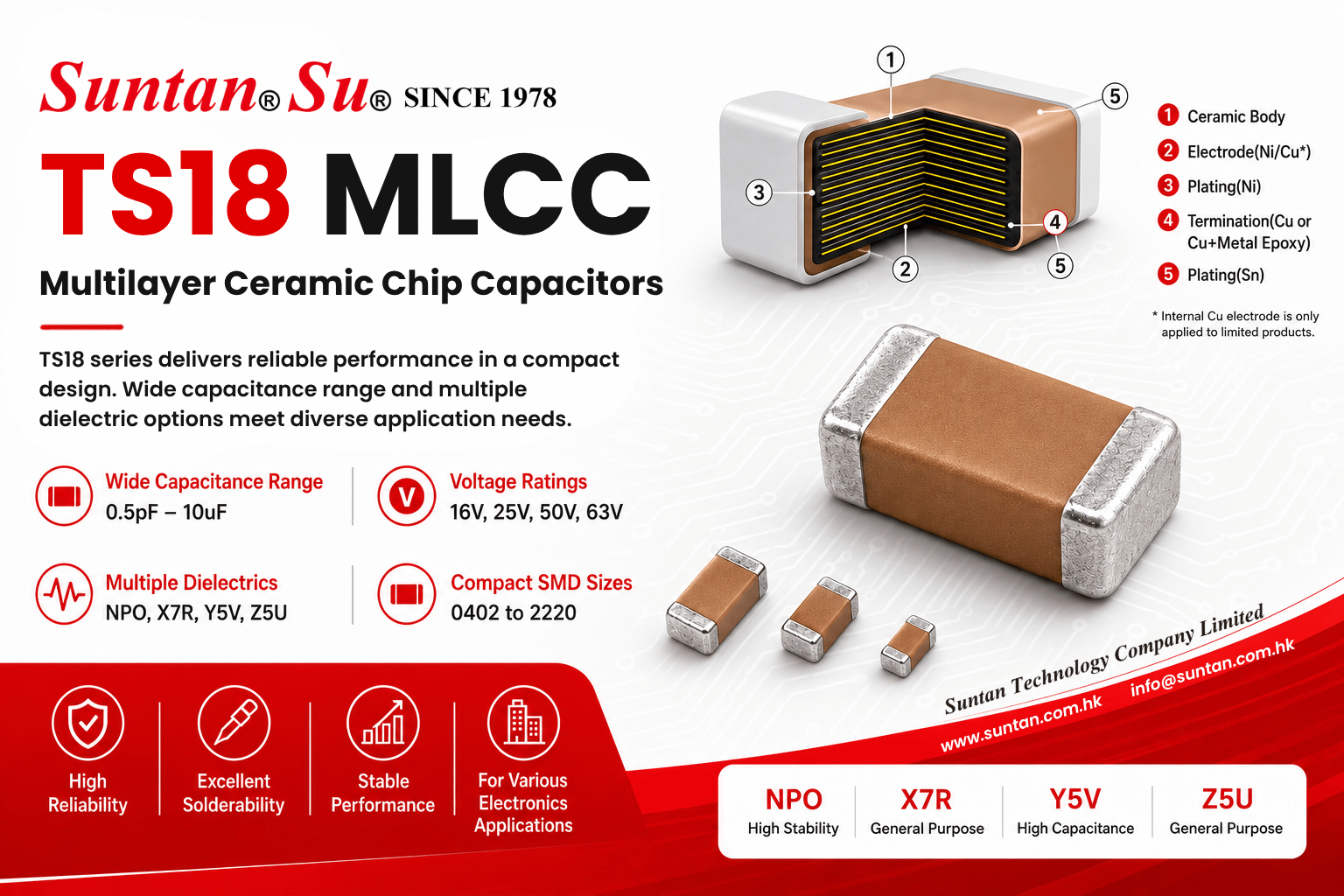
AI Server MLCC Demand Growth: How TS18 SMD MLCC Supports Modern Electronic Designs
The continuous growth of high-density computational environments, artificial intelligence server configurations, and enterprise cloud systems demands reliable circuit foundations. Hong Kong Suntan® introduces the optimized TS18 Surface Mount Multilayer Ceramic Capacitor (SMD MLCC) lineup, deliberately developed to handle tough linear decoupling and signal-filtering procedures across high-vibration power rails.
By leveraging high-grade multi-stack dielectric layering, the TS18 platform delivers exceptional inner terminal connectivity alongside minimal equivalent series resistance (ESR). This provides design engineers and procurement teams with a stable second-source alternative that minimizes circuit space footprints while providing continuous reliability under extreme power variations.
Why TS18 SMD MLCC Form Factors Are Critical for Data Infrastructure
In automated pick-and-place high-speed lines, packaging accuracy and parameter stability determine the real output yields. Unlike older wired variations, surface-mount ceramic chip configurations remove long terminal wire frames, which drastically mitigates parasitic inductance values (ESL) to sustain signal integrity at higher operating frequencies.
Suntan TS18 chip capacitors are fully protected against localized dielectric breakdown stresses, supporting consistent capacitance retention curves that are vital for multi-phase voltage regular modules (VRMs), networking routers, and complex computer system layouts....
SUNTAN TECHNOLOGY COMPANY LIMITED · ALL KINDS OF CAPACITORS
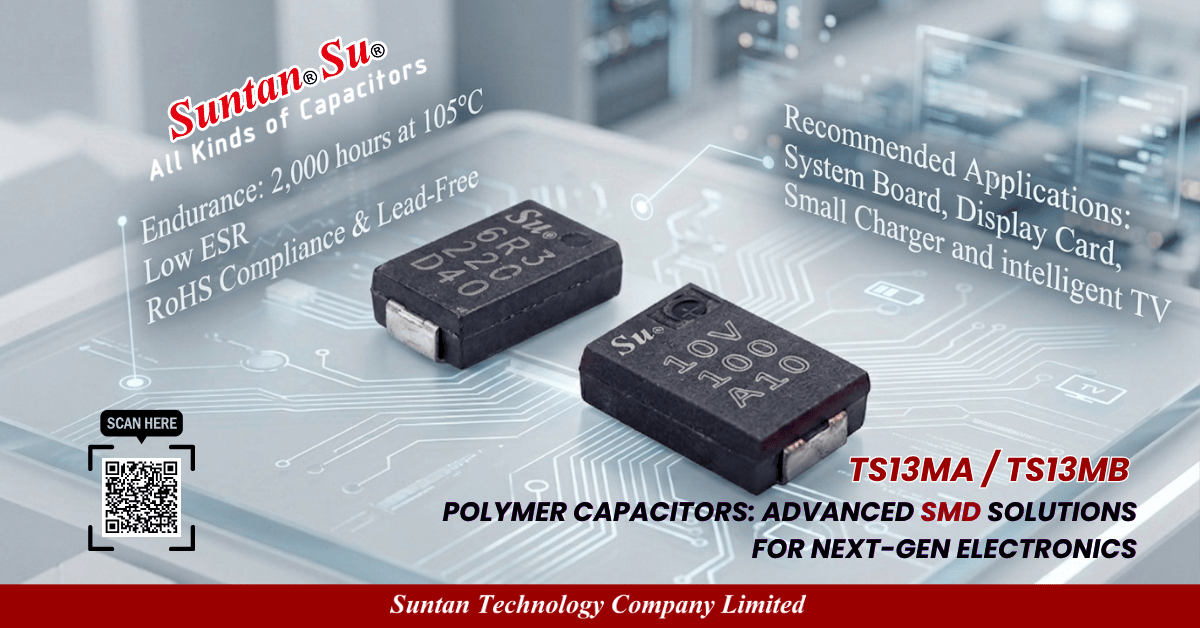
How to Choose Between TS13MA and TS13MB for System Boards, Graphics Cards, and Compact Chargers
In modern electronic circuit design, selecting the right SMD solid polymer aluminum electrolytic capacitor is critical to ensuring stability and efficiency. The Suntan TS13MA and TS13MB series are specifically engineered for applications that demand low ESR (Equivalent Series Resistance) and high reliability in compact PCB designs.
With conductive polymer technology, TS13MA and TS13MB provide a practical solution for engineers and buyers seeking superior performance in output filtering and power rail decoupling, ensuring stable operation even at high frequencies.
Why TS13MA and TS13MB Are Essential for Compact Designs
In power supplies, motherboards, and smart chargers, filtering components must handle high ripple current without sacrificing space. Unlike traditional liquid electrolytic capacitors, Suntan’s solid polymer capacitors eliminate the risk of drying out, significantly extending system lifespan.
Both TS13MA and TS13MB meet these requirements with a robust structure, making them ideal for designs focused on signal integrity and energy efficiency under continuous load conditions.
Key Features and Benefits
Feature
Technical Advantage
Application Benefit
Low ESR
Reduces energy loss and heat generation
Improves efficiency in DC/DC converters
Solid Polymer Electrolyte
No leakage or drying-out risk
Extends lifespan of system boards and chargers
Endurance: 2,000h at 105°C
High thermal stability
Suitable for industrial environments and smart TVs
SMD Package
Optimized for automated assembly
Reduces production cost and saves PCB space
Typical Applications: Where to Use TS13MA and TS13MB
These capacitors are widely used in designs requiring voltage stability and noise filtering, such as:
System Boards and Servers
High-Performance Graphics Cards
Smart Chargers and Compact Adapters
Telecommunication Equipment
Consumer Electronics and Smart TVs
Technical Resources and Video
To support component selection, we provide a video guide on the application of solid polymer capacitors in compact power designs:
SUNTAN TECHNOLOGY COMPANY LIMITED · ALL KINDS OF CAPACITORS
In AC-powered electronic circuits, choosing the right 310VAC X2 RC metallized polypropylene film capacitor is important for both safety and stable EMI performance. Suntan TS08R is designed for reliable AC line use, EMI suppression, and long-term safety-oriented performance in a wide range of electronic applications.
Built with metallized polypropylene film and an integrated resistor structure, TS08R is a practical solution for engineers and buyers looking for a dependable X2 RC safety capacitor that supports stable filtering behavior and circuit reliability under AC conditions.
Why TS08R Matters in EMI Suppression Design
In power supplies, home appliances, industrial controls, and other AC-powered systems, EMI suppression components must perform consistently under continuous voltage stress. A capacitor selected for across-the-line use should support both filtering effectiveness and application safety.
TS08R addresses these needs through its X2 safety class and RC structure, making it a useful choice for suppression-oriented designs where reliability and stable performance are both important.
Key Features of TS08R
Feature
Benefit
Application Value
310VAC Rating
Suitable for continuous AC line conditions
Supports stable operation in AC filtering circuits
X2 Safety Class
Designed for across-the-line applications
Improves suitability for safety-related AC designs
Stable electrical performance and low dielectric loss
Reliable option for long-term electronic applications
Flame-Retardant Case
Protects the component during operation
Supports safer use in demanding circuit environments
Typical Applications
TS08R can be considered for a wide range of AC-powered designs where EMI suppression, safety class requirements, and stable filtering behavior matter, including:
AC line filtering circuits
Home appliances
Power supplies
Industrial electronics
Consumer electronic products
General safety capacitor applications
For engineers evaluating a practical X2 RC film capacitor, TS08R offers a balance of electrical stability, AC voltage suitability, and safety-oriented design.
A Practical Choice for AC Line and EMI Filtering
In real-world circuit design, the right capacitor helps improve both filtering performance and long-term reliability. TS08R is a 310VAC X2 RC metallized polypropylene film capacitor developed for engineers and buyers who need a reliable solution for AC line use, EMI suppression, and safety-oriented applications.
Learn more about TS08R on the official product page or contact Suntan for further support.
SUNTAN TECHNOLOGY COMPANY LIMITED · ALL KINDS OF CAPACITORS
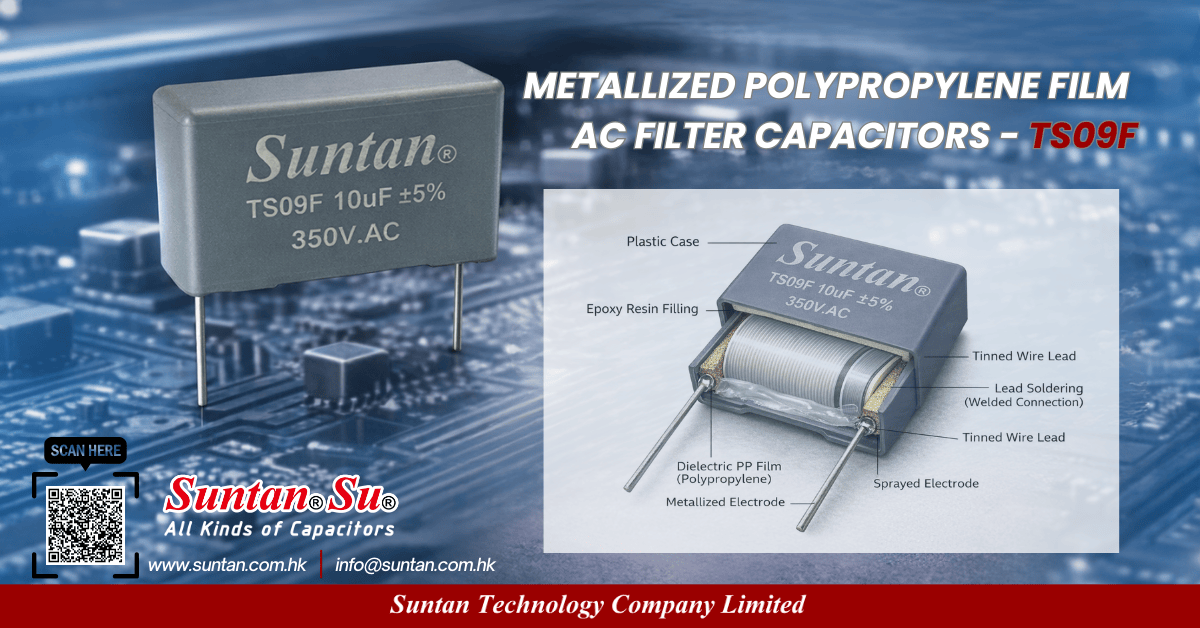
TS09F AC film capacitors are designed for demanding power electronic applications where high pulse handling, low dielectric loss, and long-term reliability matter. Built with metallized polypropylene film, the TS09F series provides excellent self-healing performance, low ESR, and strong high dv/dt withstand capability for AC filtering and resonant circuits.
For engineers working on industrial power supplies, inverters, welding equipment, or high-frequency conversion systems, capacitor stability under electrical stress is not optional. TS09F helps maintain circuit reliability by combining efficient current handling with the electrical advantages of polypropylene dielectric technology.
Why Metallized Polypropylene Matters in AC Power Designs
Metallized polypropylene capacitors are widely selected in AC and pulse applications because they offer low dissipation factor, stable capacitance characteristics, and excellent voltage endurance. Compared with general-purpose film capacitors, this structure is better suited to circuits exposed to repetitive high-frequency switching and steep voltage transitions.
In practical designs, these characteristics help reduce internal heating, improve efficiency, and support longer service life under continuous operation. This is especially important in equipment where electrical stress, temperature rise, and ripple current interact over time.
Key Electrical Advantages of TS09F
Feature
Engineering Benefit
Application Value
Metallized Polypropylene Film
Low dielectric loss and stable AC behavior
Improves efficiency in power conversion circuits
Self-Healing Structure
Localized dielectric breakdown recovery
Enhances long-term operational reliability
Low ESR
Lower internal heat generation
Supports continuous high-load operation
High dv/dt Withstand
Handles fast voltage transitions
Suitable for pulse and switching environments
AC Application Suitability
Stable under alternating current conditions
Useful for filtering, snubber, and resonant circuits
Typical Applications for TS09F AC Film Capacitors
The TS09F series is suitable for a wide range of power electronics and industrial control systems where AC handling capability and capacitor endurance are critical. Engineers may consider this series for:
Design Considerations When Selecting an AC Film Capacitor
Choosing the right AC film capacitor is not only about capacitance and voltage rating. In high-performance applications, engineers should also evaluate switching frequency, peak pulse conditions, thermal environment, and the expected electrical lifetime of the system.
For designs exposed to repeated transients or continuous AC stress, low ESR and self-healing capability become especially important. A capacitor that appears suitable on paper may still fail early if internal temperature rise and pulse conditions are underestimated during selection.
TS09F for Reliability-Oriented Power Electronics
In modern power electronics, reliability often depends on how well passive components withstand real circuit stress over time. TS09F AC film capacitors are developed to support that requirement with a balanced combination of electrical stability, pulse endurance, and long service life.
Whether your project involves industrial conversion equipment, AC filtering, or high-frequency switching design, TS09F offers a dependable polypropylene film capacitor option for engineers and sourcing teams looking for consistent performance.
Explore more capacitor solutions for AC filtering, industrial power systems, and high-frequency power electronics design.
Suntan Technology · All Kinds of Capacitors. From stable electrical performance to long-term sourcing support, we help simplify component selection for demanding designs.
SUNTAN TECHNOLOGY COMPANY LIMITED · ALL KINDS OF CAPACITORS
A seleção de varistores MOV para proteção contra surtos conforme a IEC 61000-4-5 exige dimensionamento baseado em energia, escolha correta do diâmetro do disco e posicionamento adequado na entrada de alimentação. Este guia aborda corrente de surto, tensão de clamping e arquitetura de proteção em camadas para sistemas CA.
Seleção de varistor MOV para proteção contra surtos em entrada de energia CA conforme IEC 61000-4-5
Sistemas de alimentação que passam em testes funcionais frequentemente falham durante a validação de surtos IEC 61000-4-5. Os sintomas incluem reset do controlador, perda de comunicação e travamento da fonte, indicando capacidade insuficiente de absorção de energia ou posicionamento incorreto do MOV.
Características do Surto
A IEC 61000-4-5 define uma forma de onda combinada com tensão de 1,2/50 µs em circuito aberto e corrente de 8/20 µs em curto-circuito. Essa condição apresenta energia significativamente maior que ESD e requer seleção baseada em corrente de pico e energia absorvida.
Os varistores MOV das séries TSV e TSVG cobrem tensões de 18 V a 1800 V e suportam correntes de pico elevadas de acordo com o diâmetro do disco.
Falhas Comuns de Projeto com MOV
Disco subdimensionado provoca estresse térmico em surtos repetitivos. Tensão nominal muito próxima ao valor RMS causa corrente de fuga contínua. Proteção em estágio único aumenta a tensão residual. Trilhas longas aumentam overshoot por indutância parasita.
Relação entre Diâmetro do Disco e Energia
Disco
Capacidade de Surto
Aplicação
5D
Baixa energia
Proteção DC secundária
7D
Energia moderada
Adaptadores e SMPS
10D
Baixa potência industrial
Placas de controle
14D
Alto surto
Drives de motores
20D
Surto muito alto
Distribuição CA
Discos maiores aumentam a corrente de pico e a energia suportada, porém elevam a capacitância e o espaço ocupado na PCB.
Seleção Orientada por Parâmetros
Determinar a tensão RMS máxima da rede. Identificar o nível de surto linha-linha e linha-terra. Calcular a corrente de pico 8/20 µs. Selecionar o disco com margem de energia. Verificar a tensão de clamping em relação aos componentes a jusante.
Considerações Térmicas e Vida Útil
A degradação do MOV é cumulativa. Cada surto aumenta a corrente de fuga e altera a tensão do varistor. O projeto deve considerar espaçamento térmico e evitar operação próxima ao limite de tensão contínua.
Estratégia de Posicionamento
Posicionar o MOV na entrada de energia com trilhas curtas. Instalar entre fase e neutro para proteção diferencial. Adicionar MOV fase-terra conforme a categoria de surto.
Arquitetura de Proteção em Camadas
O MOV absorve alta energia, porém a tensão residual pode exigir um clamp secundário no barramento DC e um choke de modo comum para reduzir o estresse nos circuitos de controle.
Exemplo de Aplicação AC-DC
Entrada 230 VCA com requisito de surto de 1 kV linha-linha e 2 kV linha-terra. Utilizar MOV 14D entre fase e neutro com impedância em série antes da ponte retificadora. Verificar a tensão no barramento DC durante o surto.
Método de Verificação
Medir a tensão de clamping no barramento DC. Monitorar a temperatura do MOV em surtos repetitivos. Verificar corrente de fuga após testes. Validar recuperação funcional do sistema.
Parâmetros Necessários
Tensão RMS CA e tolerância. Nível de surto e modo de acoplamento. Forma de onda de corrente de pico. Número de pulsos. Tensão máxima de clamping. Espaço disponível na PCB.
Conclusão
A conformidade com a IEC 61000-4-5 requer seleção de MOV baseada em energia, corrente de pico, diâmetro do disco e posicionamento adequado. A proteção coordenada reduz o estresse residual e aumenta a confiabilidade do sistema.