How to Choose Between TS13MA and TS13MB for System Boards, Display Cards, and Small Chargers
SUNTAN TECHNOLOGY COMPANY LIMITED · ALL KINDS OF CAPACITORS
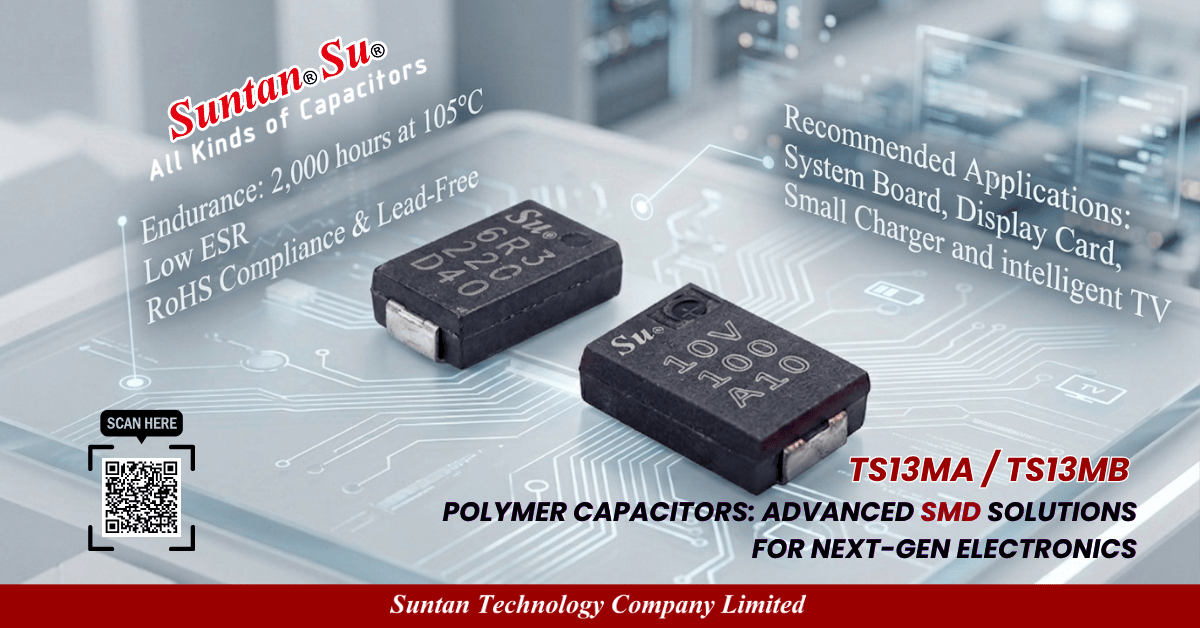
How to Choose Between TS13MA and TS13MB for System Boards, Graphics Cards, and Compact Chargers
In modern electronic circuit design, selecting the right SMD solid polymer aluminum electrolytic capacitor is critical to ensuring stability and efficiency. The Suntan TS13MA and TS13MB series are specifically engineered for applications that demand low ESR (Equivalent Series Resistance) and high reliability in compact PCB designs.
With conductive polymer technology, TS13MA and TS13MB provide a practical solution for engineers and buyers seeking superior performance in output filtering and power rail decoupling, ensuring stable operation even at high frequencies.
Why TS13MA and TS13MB Are Essential for Compact Designs
In power supplies, motherboards, and smart chargers, filtering components must handle high ripple current without sacrificing space. Unlike traditional liquid electrolytic capacitors, Suntan’s solid polymer capacitors eliminate the risk of drying out, significantly extending system lifespan.
Both TS13MA and TS13MB meet these requirements with a robust structure, making them ideal for designs focused on signal integrity and energy efficiency under continuous load conditions.
Key Features and Benefits
| Feature | Technical Advantage | Application Benefit |
|---|---|---|
| Low ESR | Reduces energy loss and heat generation | Improves efficiency in DC/DC converters |
| Solid Polymer Electrolyte | No leakage or drying-out risk | Extends lifespan of system boards and chargers |
| Endurance: 2,000h at 105°C | High thermal stability | Suitable for industrial environments and smart TVs |
| SMD Package | Optimized for automated assembly | Reduces production cost and saves PCB space |
Typical Applications: Where to Use TS13MA and TS13MB
These capacitors are widely used in designs requiring voltage stability and noise filtering, such as:
- System Boards and Servers
- High-Performance Graphics Cards
- Smart Chargers and Compact Adapters
- Telecommunication Equipment
- Consumer Electronics and Smart TVs
Technical Resources and Video
To support component selection, we provide a video guide on the application of solid polymer capacitors in compact power designs:
Datasheet Downloads:
TS13MA Datasheet | TS13MB Datasheet


