Introducing the New Suntan TS23C Mica Capacitors: High Reliability, Stability, and Moisture Resistance
Suntan Technology Company Limited
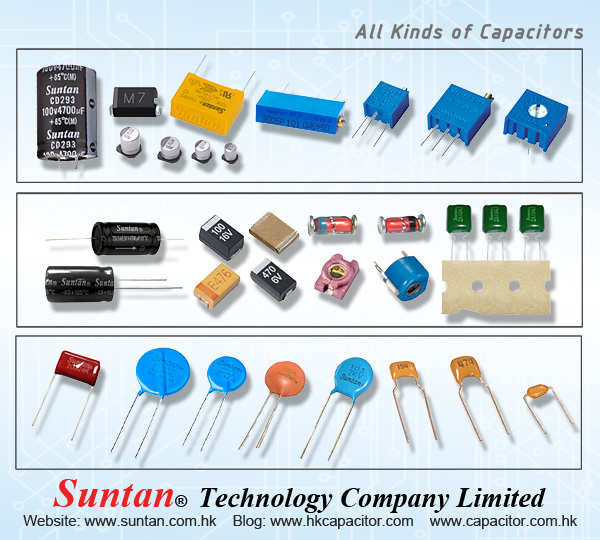
----All Kinds of Capacitors
Dear Friends,
We are excited to announce the launch of our new TS23C Mica Capacitors, designed to deliver exceptional reliability, stability, and compactness with high moisture resistance. These capacitors are ideal for demanding applications that require high performance and durability.
Why Choose TS23C Mica Capacitors?
Mica is one of the oldest dielectric materials used in capacitor construction due to its outstanding electrical, mechanical, and chemical stability. It offers a dielectric constant in the range of 5–7 and is composed of various natural materials, including iron, sodium, ferric oxide, and lithium. The careful inspection and classification of mica destined for capacitor use ensure high-quality and performance, albeit at a higher manufacturing cost.
Superior Specifications
The TS23C Mica Capacitors come in three types with a wide range of capacitance values and rated voltages, making them versatile for various applications. Here are the detailed specifications:
| Type | Capacitance Range | Tolerance | Rated Voltage | Operating Temperature |
| 1210 | 1pF – 91pF | ±5 | DC 500V | Subject to 125±2°C for 2 hours. Insulation resistance ≥ 5G OHMS |
| 1812 | 1pF – 470pF | ±5 | DC 500V | Subject to 125±2°C for 2 hours. Insulation resistance ≥ 5G OHMS |
| 2220 | 330pF – 1000pF | ±5 | DC 500V | Subject to 125±2°C for 2 hours. Insulation resistance ≥ 5G OHMS |
Key Benefits
The TS23C Mica Capacitors offer several advantages that make them stand out in the market:
◼ High Reliability and Stability: Mica capacitors are known for their minimal voltage dependence and high Q factors, which remain consistent across different frequencies. This makes them ideal for high-frequency and RF applications.
◼ Compact and Space-Efficient: These capacitors have a compact design that saves space in electronic circuits, contributing to overall system miniaturization.
◼ High Moisture Resistance: The airtight enclosure of TS23C Mica Capacitors prevents oxidation or corrosion of the plates and connections, enhancing their durability and longevity.
◼ Greater Value per Volume: The absence of airgaps between plates and mica allows for thinner conducting surfaces, maximizing the capacitance value per unit volume.
◼ Simplified Design: The elimination of a clamping mechanism simplifies the design and assembly process, reducing complexity and potential points of failure.
Ideal Applications
Due to their high precision, stability, and reliability, Suntan TS23C Mica Capacitors are perfect for high-frequency and RF applications. They provide consistent performance in demanding environments, making them a trusted choice for engineers and designers.
Learn More
For more detailed information about the TS23C Mica Capacitors, please download the TS23C Mica Capacitor Specifications PDF.
Contact Us
For inquiries or more information, feel free to contact our sales team at sales@suntan.com.hk or info@suntan.com.hk. We look forward to supporting your projects with our high-quality capacitors.
Experience unparalleled reliability and performance with Suntan TS23C Mica Capacitors, designed for the most demanding applications.
Website:🌐https://www.suntan.com.hk/ Youtube:🎥https://www.youtube.com/@SuntanTechnology
All Kinds of Capacitors – All Kinds of Capacitors, Your Trusted Partner in Electronic Components.