From 0.8A to 35A: Choosing the Right Bridge Rectifier for Your Power Design
SUNTAN TECHNOLOGY COMPANY LIMITED · BRIDGE RECTIFIERS SPECIALIST
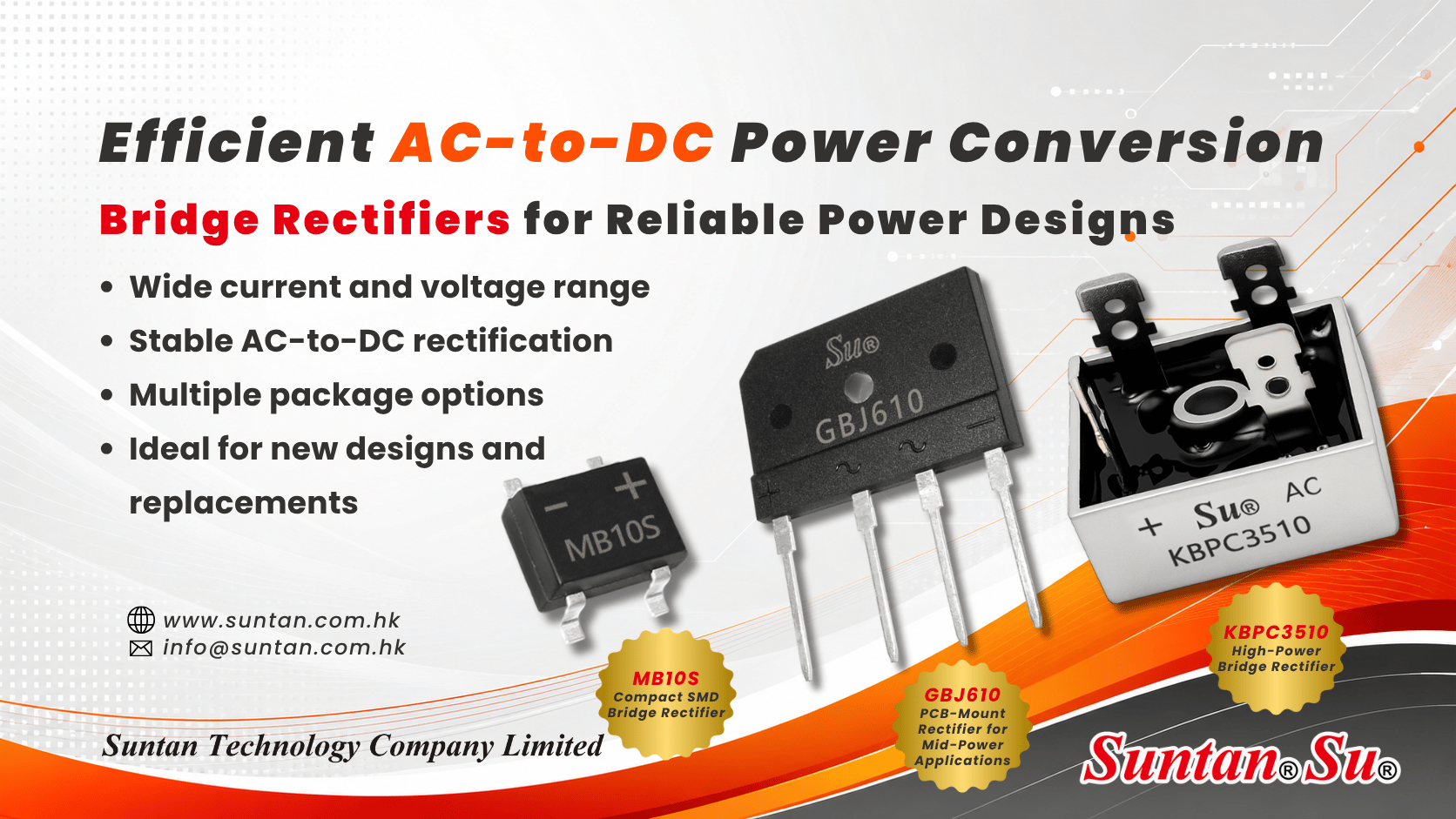 Figure 1: Comprehensive Suntan® bridge rectifier lineup spanning from low-profile 0.8A SMD MB10S to heavy-duty 35A industrial rectifiers.
From 0.8A to 35A: Choosing the Right Bridge Rectifier for Your Power Design
In modern AC-to-DC power conversion architectures, selecting the optimal full-wave bridge rectifier is a fundamental engineering requirement. Whether designing low-power SMT consumer chargers, medium-power industrial PCB control boards, or heavy-duty power inverters, power electronics engineers must evaluate key parameters including average forward current (IF(AV)), maximum peak reverse voltage (VRRM), peak forward surge current (IFSM), and thermal dissipation efficiency.
Suntan Technology Company Limited® offers an extensive portfolio of silicon bridge rectifiers engineered for high reliability, low forward voltage drop, and high surge capability. From space-saving 0.8A SMD packages like the MB10S to 6A PCB-mounted models like the GBJ610, up to heavy-duty 35A industrial chassis rectifiers such as the KBPC3510 and S35VB005–S35VB100 series, Suntan provides scalable power rectification options across global commercial and industrial applications.
Why Current Rating, Reverse Voltage, and Package Selection Matter
Selecting an under-specified bridge rectifier can lead to thermal runaway, excessive forward voltage dissipation, or destruction from line transients and initial bulk capacitor inrush currents. To ensure long-term field reliability, hardware designers must balance electrical margins with mechanical constraints:
- Average Rectified Forward Current (IF(AV)): The maximum continuous DC current the rectifier can safely pass without exceeding its junction temperature limits. Applying a 30% to 50% safety de-rating margin above maximum continuous circuit load is highly recommended.
- Peak Reverse Voltage (VRRM): The maximum repetitive voltage the diode junction can block in reverse bias. For 110V/220V AC utility line inputs, selecting a 1000V VRRM rating (e.g., MB10S, GBJ610, KBPC3510) guards against power grid voltage spikes and inductive switching surges.
- Thermal Management & Casing: Low-current SMD rectifiers dissipate heat through PCB copper traces. Mid-to-high current rectifiers (6A to 35A) feature single-in-line or square metal/ceramic housings designed for external aluminum heatsinks to handle heavy power losses.
Technical Parameters and Bridge Rectifier Series Comparison
The table below summarizes key technical parameters for primary Suntan® bridge rectifier series across current ratings, package styles, and target applications:
| Bridge Rectifier Series | Current / Voltage Rating | Package & Mounting Type | Primary Application Focus | Datasheet Reference |
|---|---|---|---|---|
| MB10S | 0.8A / 1A | 1000V VRRM | MBS Miniature Surface Mount (SMD / SMT) | Compact PCB power supplies, smart meters, LED drivers, consumer adapters. | Download MB10S PDF |
| GBJ610 | 6A | 1000V VRRM | GBJ Single In-Line Package (SIP Through-Hole) | Mid-power PCB power supplies, home appliances, industrial control boards. | Download GBJ610 PDF |
| KBPC3510 | 35A | 1000V VRRM | KBPC Metal Casing (Chassis Mount with Faston/Wire Leads) | Heavy industrial power supplies, battery chargers, arc welders, motor drives. | Download KBPC3510 PDF |
| S35VB005–S35VB100 | 35A | 50V to 1000V VRRM Options | S35VB Industrial Square Metal/Ceramic Housing | High-current AC-to-DC converters, power inverters, industrial automation power rails. | Download S35VB PDF |
Technical Demonstration Video Review
To evaluate component footprint configurations and physical terminal layouts for your power schematic, review our technical product video below:
People Also Ask — Technical Selection FAQ
Calculate the maximum continuous DC output load current (IDC) of your circuit and apply a safety de-rating factor of 30% to 50% (or higher for inductive motor loads). This overhead accommodates elevated ambient operating temperatures and prevents device thermal runaway.
SMD bridge rectifiers (such as the MB10S) are optimized for automated high-speed SMT assembly in compact, low-power designs. Through-hole models (such as the GBJ610) feature leads passing through PCB holes, providing stronger mechanical anchoring and better thermal dissipation for medium-to-high power converters.
Select a peak reverse voltage rating at least 1.5× to 2× higher than the peak AC input voltage (VAC_peak = VRMS × 1.414). For standard 220V/240V AC line applications, choosing a 1000V rated model (such as MB10S, GBJ610, or KBPC3510) provides ample protection against line transients.
Yes. Electrically, a higher-current bridge rectifier (e.g., replacing a 6A model with a 35A series) can safely substitute for a lower-current device. However, engineers must verify physical pin pitch, lead dimensions, terminal type, and heatsink clearance on the PCB or chassis.
Both KBPC3510 and S35VB100 deliver 35A 1000V AC-to-DC rectification. The key distinctions involve housing dimensions, internal construction layout, mounting hole isolation, and terminal configurations (such as faston tab terminals vs wire pin leads) for specific chassis installations.
Surge current (IFSM) represents the maximum non-repetitive peak forward surge current the rectifier diode junctions can withstand for a single half-sine wave pulse (typically 8.3ms at 60Hz). A robust IFSM rating is essential to handle bulk filter capacitor charging inrush current upon power turn-on.
Yes. When operating at high continuous currents, internal diode forward voltage drop causes significant power loss (P = VF × Iload). Heavy-duty 35A rectifiers like KBPC3510 and S35VB require an adequately sized aluminum heatsink with thermal compound to maintain safe junction temperatures.
The MB10S miniature SMD bridge rectifier is an ideal choice for compact PCB power converters due to its low-profile MBS package, automated SMT compatibility, high reliability, and standard 1000V peak reverse voltage capability.
Yes. The GBJ610 features a slim single-in-line (SIP) footprint that minimizes PCB surface area usage while allowing easy mounting of a vertical metal heatsink for up to 6A continuous output current.
Sourcing teams should specify required average forward current (IF), maximum peak reverse voltage (VRRM), package style (SMD, GBJ, or KBPC), expected order volume, and application target when submitting a Request for Quotation (RFQ) to Suntan.
Suntan® supports industrial power supplies, motor control units, and commercial electronics with reliable bridge rectifier solutions. For volume pricing and technical sample evaluation, please contact our support team.
