Why Conduction Cooling Matters in High-Power Capacitor Design
SUNTAN TECHNOLOGY COMPANY LIMITED · HIGH-POWER FILM CAPACITOR SPECIALIST
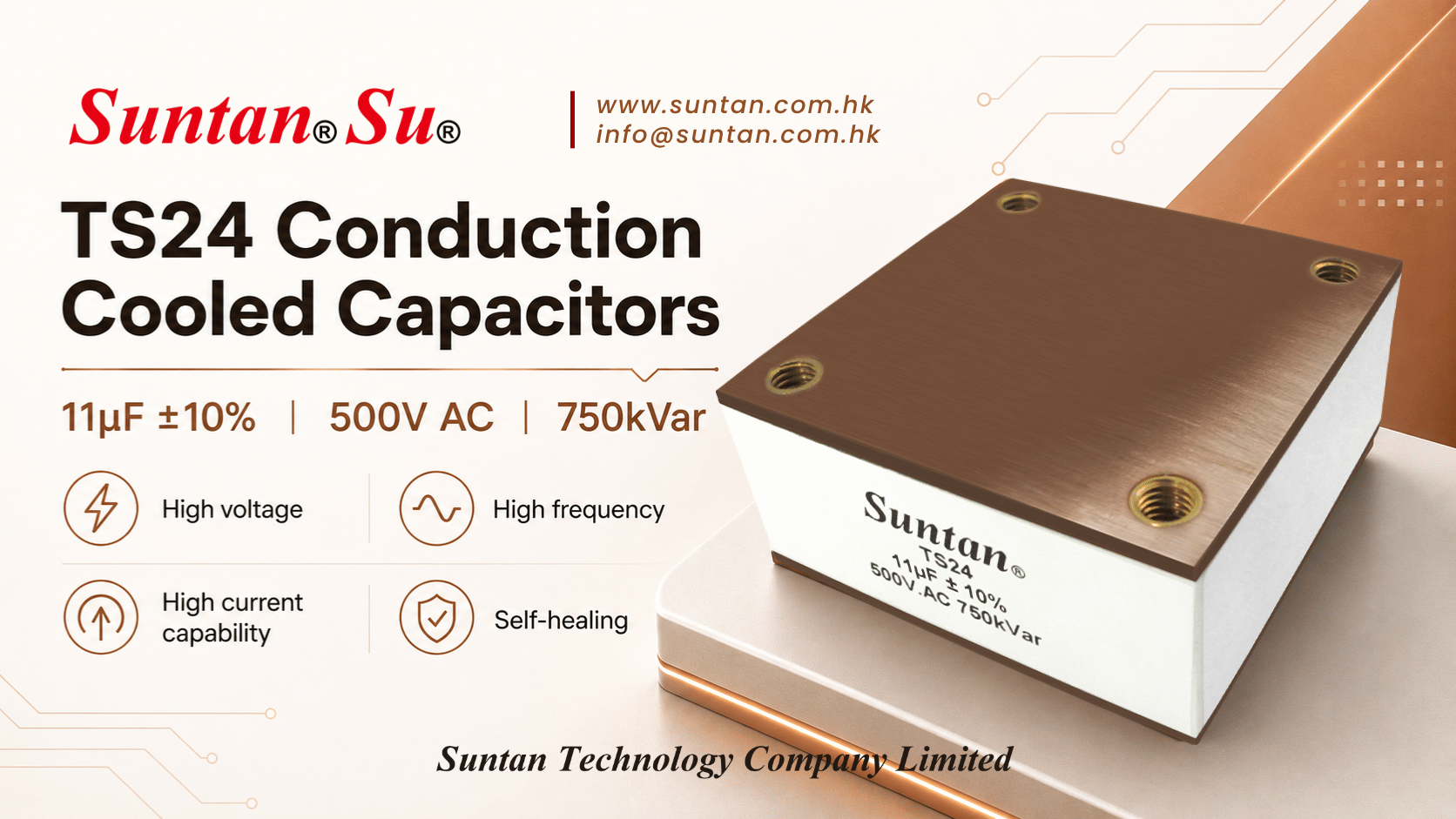 Figure 1: Suntan® TS24 conduction cooled capacitor designed with heavy-duty mounting surfaces for direct cold-plate thermal management.
High-Power Thermal Management with Conduction Cooled Capacitors: Engineering Insights on Suntan TS24
In next-generation medium- and high-frequency power electronics, thermal dissipation is frequently the ultimate bottleneck limiting system miniaturization and power density. As switching frequencies rise into the tens and hundreds of kilohertz and circulating currents surge past several hundred amperes, conventional convective airflow cooling methods rapidly reach their physical limits.
As an experienced conduction cooled capacitor manufacturer, Suntan Technology Company Limited® engineered the TS24 Series specifically for high-power, high-frequency resonant circuits. By conducting internally generated thermal energy directly into mounting surfaces, busbars, and liquid-cooled cold plates, the TS24 delivers low thermal resistance, high dv/dt endurance, and exceptional reactive power handling (up to 800 kVar) within a remarkably compact envelope.
Why Conduction Cooling Outperforms Air Cooling in High-Power Systems
Operating high-power film capacitors inside compact, dust-proof, or liquid-tight enclosures (such as IP65/IP67 cabinets) presents significant thermal challenges:
- Direct Solid-State Heat Path: Instead of relying on low-efficiency air convection, the TS24 establishes an ultra-low thermal resistance (Rth) interface by bolting directly to chassis heatsinks or water-cooled copper cold plates.
- Internal Hotspot Prevention: Massive circulating tank currents generate Joule heating. Direct conduction pulls heat away immediately from the low-loss dielectric winding, preventing hotspot buildup and thermal runaway.
- Compact Enclosure Compatibility: Ideal for space-constrained power converters where forced air fans cannot be deployed due to acoustic noise, contamination, or hermetic sealing requirements.
- Extended Service Reliability: Under controlled hotspot temperatures, the TS24 provides stable capacitance values and an operational lifespan of up to 200,000 hours at rated conditions.
Suntan® TS24 Series Technical Specifications Matrix
The table below outlines the core operating ratings, dielectric characteristics, and documentation references for the Suntan TS24 series:
| Series Platform | Dielectric & Cooling Structure | Key Electrical Ratings | Reactive Power (kVar) | Datasheet Documentation |
|---|---|---|---|---|
| TS24 Series | Low-loss Polypropylene Film / Direct Conduction Plate & Busbar Mount | Rated Voltage: 400 VAC – 1,000 VAC; Capacitance: 0.1 μF – 84 μF; tan δ ≤ 5 × 10⁻⁴ (1 kHz) | 300 kVar, 600 kVar, 750 kVar, 800 kVar | View TS24 Product Page & PDF |
Key Industrial Applications for Conduction Cooled Capacitors
The TS24 series is engineered to excel in demanding environments requiring continuous high-power throughput and extreme frequency stability:
- Induction Heating & Melting Furnaces: Serves as the primary resonant tank capacitor, carrying hundreds of amperes across LC tank circuits while bolted to liquid-cooled copper plates.
- High-Frequency Inverters & Resonant Converters: Provides reactive compensation and energy storage in LLC, LCC, and full-bridge zero-voltage switching (ZVS) topologies.
- High-Power Industrial Welding: Withstands heavy pulse loads, repetitive high-current discharges, and high dv/dt commutation transients.
- EV High-Power Wireless Power Transfer (WPT): Delivers primary- and secondary-side magnetic resonant coupling with high Q factor and minimal transmission losses.
Engineering Selection Checklist for High-Power Film Capacitors
When sizing a conduction cooled capacitor for your system, hardware designers should systematically verify the following six parameters:
- 1. Working AC/DC Voltage: Check continuous RMS voltage, peak working voltage, and worst-case harmonic overvoltage headroom.
- 2. Continuous RMS Current (IRMS): Verify maximum circulating current against current-frequency de-rating curves to prevent thermal overload.
- 3. dv/dt Withstand Capability: Ensure the capacitor's dv/dt rating (V/μs) safely handles switching rise times (Ipeak = C × dv/dt).
- 4. Operating Frequency: Match operational tank frequency with dielectric dissipation factor (tan δ) to minimize high-frequency ESR losses.
- 5. Thermal Path & Heatsink Interface: Ensure mounting plate flatness (≤0.05 mm), apply thin thermal interface material (TIM), and torque busbar mounting bolts evenly.
- 6. Reactive Power Rating (kVar): Verify required kVar demand under continuous maximum duty cycle.
People Also Ask — Conduction Cooled Capacitor Engineering FAQ
A conduction cooled capacitor is a specialized high-power, high-frequency capacitor designed to transfer internally generated heat away via direct contact with an external heatsink, cold plate, or heavy-duty busbar mounting surface, rather than relying on natural or forced-air convective airflow. This solid-state thermal path provides vastly superior thermal conductivity and allows components to withstand hundreds of kilovolt-amperes reactive (kVar) in compact footprints.
Explore TS24 Conduction Cooled Design →Engineers should specify conduction cooled capacitors when power conversion designs encounter extreme RMS currents (hundreds of amperes), high operating frequencies (tens to hundreds of kHz), compact sealed enclosures (such as IP65/IP67 equipment), or environments with limited or prohibited airflow where conventional convective cooling cannot prevent thermal runaway.
Conduction cooling establishes a direct metallic thermal path with minimal thermal resistance (Rth) between the internal film winding and the cooling plate. By removing heat effectively through the mounting surface, internal core hotspot temperatures are kept low, stabilizing capacitance, suppressing dielectric stress, and ensuring long-term operational reliability under full-load operation.
dv/dt defines the maximum rate of voltage change across the capacitor over time (expressed in V/μs). In high-frequency resonant circuits and fast-switching inverter bridges, rapid commutations create severe dv/dt spikes. High dv/dt capability ensures that the capacitor withstands large repetitive peak currents (Ipeak = C × dv/dt) without dielectric breakdown or terminal metallization failure.
Equivalent Series Resistance (ESR) represents the internal ohmic losses within the dielectric film and metallized terminations. Because power dissipation scales with the square of the RMS current (Ploss = IRMS2 × ESR), ultra-low ESR is critical to suppressing self-heating, preserving electrical efficiency, and preventing destructive thermal breakdown.
Review Low-ESR TS24 Technical Specs →Yes. Conduction cooled capacitors are the foundational component in induction heating and melting equipment. Connected in series or parallel with work coils to form resonant tank circuits (LC tanks), they manage continuous reactive power (300 kVar to 800 kVar+) and hundreds of amperes of high-frequency circulating current while bolted to water-cooled cold plates.
Absolutely. Conduction cooled capacitors such as the Suntan TS24 are purpose-engineered for series and parallel resonant converters (LLC, LCC, and tank configurations). Their tight capacitance tolerance, high Q factor, low dissipation factor (tan δ), and extreme current capacity ensure precise resonant frequency tuning and minimal loss under high-frequency excitation.
Key applications include induction heating and melting furnaces, high-frequency resonant power supplies, industrial welding machinery, high-power wireless EV charging systems (WPT), plasma power generators, and medical RF power equipment.
Follow a structured selection checklist: 1) Verify operating AC/DC voltage ratings; 2) Determine maximum continuous RMS current and switching frequency; 3) Confirm peak dv/dt withstand capability; 4) Check required reactive power (kVar); 5) Review mounting interface flatness, thermal interface material (TIM), and busbar connection torque.
When operated strictly within designated electrical ratings and temperature limits—supported by proper cold-plate or heatsink thermal management—Suntan TS24 conduction cooled capacitors can achieve an expected service life of up to 200,000 hours at rated conditions. Exceeding rated hotspot temperatures or operating margins will accelerate dielectric aging and reduce service life.
Suntan® supports high-power electronics, induction heating equipment, and resonant power converter manufacturers worldwide. For cross-referencing, custom terminal mounting, or sample requests, please contact our technical team.
